Showing posts with label childhood. Show all posts

Friday, October 22, 2010

Consumer, cow, milkman, roses, tulsi: one ecosystem

When I was little, we got our milk delivered straight from the buffalo sheds a few miles away (this was still Bombay, not somewhere in the countryside). The milkman had a bunch of buffaloes (or tended someone else's), and brought milk in large aluminum buckets, like the one on the left, and measured out as much as my mom wanted, into a large saucepan from the kitchen.

There was no packaging at all, no waste, and the milk had to be 100% fresh or else you'd know at once (it's warm here so fresh milk doesn't keep long unless you pasteurize by boiling). Sometimes the milkman would bring me a rose from the bush that grew by the shed. And when we wanted fertilizer for our house plants, he'd bring a dung cake (dry, not stinky). We'd pound it into a very coarse powder and scatter it in the tulsi pots. One cowpat is quite a lot of fertilizer!

It was such a wonderful, simple and environment-friendly system, and the producers (buffalo and milkman) were a more direct part of the lives of us consumers, not separate. The milk man died, the sheds got moved out, and we now get our milk and fertilizer in plastic packets, and the roses come from commercial farms with a massive carbon footprint (refrigerated trucks or planes). We have no idea who feeds the buffaloes or tends the flowers, what their names are (our milkman was Udit Narayan), whether they look healthy and are paid well, and how fresh or pure the milk truly is.

Friday, December 5, 2008

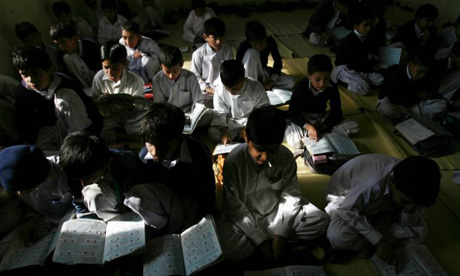
Open house at Jamaat-ud-Daawa

As Pakistan comes under great international pressure, this controversial charity, widely regarded as a front for the Lashkar-e-Taiba, opened its doors to journalists -- the doors to its classrooms and hospital. Other areas of the campus remained out of bounds. While the BBC appears to have taken this PR exercise at face value, the Guardian has not. It wrote that the
carefully orchestrated visit took foreign and local journalists around the beautifully equipped school and hospital. The school follows the national curriculum, the headteacher, Rashid Mehnaz, said, taking pupils from around the country. The poor were given financial help, with richer pupils paying fees. Mehnaz condemned violence, saying suicide attacks were "absolutely wrong - it is forbidden in Islam".

A press conference and sumptuous lunch was laid on for journalists. However, the madrasa, mosque, and other facilities remained out of bounds, and once the official tour was over the media were no longer welcome. Although the group had said anyone was welcome to look around the site at any time, the Guardian's attempt to take up this offer after the tour was met with a heavy-handed response: burly young men arrived on motorcycles and circled, demanding that we leave...

...Certainly there were plain-clothed officials present, who said they were members of "special branch" - often a euphemism for the Pakistan's ISI intelligence agency. They wanted to provide an armed escort back to Lahore, but why intelligence agents were there - and why an escort might be necessary - was unclear. Muridke is not in a dangerous part of Pakistan, and the offer was declined.

It has long been said that the ISI has secretly backed Lashkar-e-Taiba, though the agency always rejects the accusation.

Tuesday, June 3, 2008

A Mumbai summer ends

Mumbai has been intolerably humid. The air was so still and thick with humidity that I felt I simply couldn't bear it. Neither my nor my friends' homes have air conditioning. Nor do the buses, trains, nor most taxis. But bear it I did, simply because there was nothing else to do. These past few weeks, the air conditioning at my workplace was a sort-of incentive to go to work. (I say "sort of" because they crank the damn thing up until your brain freezes and your fingers stop moving. That's not very pleasant, either.)

A couple of hours ago, it rained -- a heavy shower for a good 20 minutes. It's like someone turned the air conditioning on for the whole neighborhood. It's dark now, and although tomorrow Mumbai is sure to be back to its nasty muggy self, at least the dust will have washed off the leaves, and the air, normally a yellowy-brown despite the year-round coastal breeze, will be a little clearer.

For the rest, here are a few glimpses of Mumbai's summer. Photos by yours truly. If you want to use them, ask me, okay?


Saturday, May 24, 2008

New York through the muckraker's lens

"Five cents a spot", by Jacob Riis, 1889. Image source: The New York Times

When I was about 16 or 17, the brother of a girl in my college (I think she was called Deepa), who went to Brandeis, brought back a book on one of his visits home. That book was called American Pictures, by Jacob Holdt. A friend of mine borrowed that book from Deepa, and I borrowed it from her (Jacob Holdt touched many lives in India with that one much-borrowed copy of his book!). And so I learned that there was poverty in America. And I learned that another Dane, Jacob Riis, had recorded alarmingly similar wrenching poverty a century before Holdt. Thanks, Deepa's brother!

The New York Times today has a review of a new book on Jacob Riis, titled Rediscovering Jacob Riis: Exposure Journalism and Photography in Turn-of-the-Century New York. Daniel Czitrom, professor of history at Mount Holyoke College, co-author of the book with Bonnie Yochelson, art historian at the School of Visual Arts in Manhattan, is quoted in the NYT as saying:

“I’ve always been struck by the tension between the empathy and sympathy that’s powerfully depicted in many of those images, and the kind of stereotypes, racial language, that he uses in the text... There’s a tension between the text and the photographs. Today, no one really reads Riis anymore, and yet the photographs remain incredibly moving.”

The NYT reviewer, Sewell Chan, writes:

The commonly held view of Riis is that of the muckraking police reporter, whose seminal 1890 work, “How the Other Half Lives,” prompted legislative reforms, focused attention on the desperate lives of poor urban immigrants and left an enduring mark on the history of documentary photography.

Less well-known are the contradictory elements of Riis’s life and work. He was an entertainer, a self-promoter, an evangelical, and a political conservative who had little faith in the power of government to correct social ills, arguing instead for Christian charity. He held views on race and ethnicity that would be considered offensive today. Though he is now heralded as a major figure in photographic history, he declared in his 1901 autobiography that he was “downright sorry to confess here that I am no good at all as a photographer.”

"The Baby's Playground", by Jacob Riis, c. 1890. Image source: The New York Times

Monday, January 21, 2008

Photos I regret not taking

We all see beautiful or moving moments that we couldn't photograph for some reason. In my case, more often than not, it's because I was too lazy or disorganized to take my camera along. I created this new tag so I can share the images that now exist only in my head.

To start off, a really old image, and one from last night.

Sometime in April/May 1990. Beach on the Andhra coast, somewhere near the estuary of the Godavari and the town of Narasapur. Blue sky, empty beach, quite barren - just a little bit of scrub - and scores of iridescent red crabs teeming astonishingly on clean white sand. Sarojamma breaks off from our little group of women who had briefly stopped there, and, in a moment of exuberance, runs towards the crabs, sending them scurrying in all directions in a panic. Just remembering Sarojamma's impulsive joy gives me a sense of freedom.

Sunday, January 20, 2008. Mumbai Festival event in the amphitheater on the Carter Road promenade, Khar/Bandra. An Australian hip-hop band called Downsyde is playing on
the stage, egging the audience on to sing along, raise their hands in the air, and dance. During the last couple of songs, the little area near the stage is packed with dancers. Two little kids, a girl of around four, with a cloud of curls, and a younger boy appropriately sporting a wool beanie, are up on the stage with the four hip-hoppants, three of whose names I remember as Shabazz, Armee, and Dazaztah (sp?). The little girl, especially, had a great sense of rhythm, and even improvised in time to the music improvisations, hurling her little arms in the air with abandon. Joy!

Just realized as I typed the last full stop - they're both seaside moments of joy...

Sunday, June 10, 2007

What's worse than terrorism?

Cho Seung-Hui, they said, had issues. Guns don't kill people; people kill people. So what's the real issue when the killer -- and victim -- is two years old?

Gary Younge of The Guardian finds that on an average day, eight children are killed in the US by guns. That's 2920 children in a year -- more than the number of people who died in the World Trade Center on 9/11. The foregoing link leads to an audio clip, in which Younge tells the stories of some of the nine children who died on a day he chose at random (November 25, 2006, Thanksgiving Sunday). One of these was a two-year-old in Tampa, FL, who found a gun behind a sofa cushion, and accidentally shot himself in the chest. On an average day, eight US children die from gunshots: four white, three black, one Hispanic; on that day, there were eight black and one Hispanic. Most are poor.

The original argument for guns in the Second Amendment, Younge notes, was self-defense against tyrannical government; today, the argument pro-gun Americans make is self-defense against each other!

Younge adds that there is very little interest in America in gun-related deaths, which are a "regular occurrence". In one case, the victim was not even named in a news report; the police never even thought to issue a press release.

Left: Still from a video of Andrew, five-year-old son of Lisa Nawrot, psychology professor at Minnesota State University, finding a .32 Beretta hidden in his playroom. "Not only did he pick up the gun, he aimed it and pulled the trigger before he came to get me," said Nawrot. The video was part of a study by Kristen McIntyre on how children aged 5-6 would react if they found a gun. Results showed that, no matter how much parents warned or taught their children about guns, and no matter how familiar children were with guns, it didn't necessarily prevent them from handling the weapon dangerously.The guns used in the study had, of course, been disabled by the local Sheriff's department.

Afterthought: What does it say about a culture that children's behavior with guns is even a research question?

Update: A few hours after I posted the above, I read that another two-year-old, this time in Wisconsin, has become a victim of gun violence. She is alive, but in critical condition. Why can't America make itself safe for its children?

Friday, March 16, 2007

More than mullahs

An American friend sent out these images out of concern that her country might go and change Iran's landscape, the way it has Iraq's. Here's what her e-mail made me think, and what I wrote to her:
The first I heard about the horrific brutality of the Iranian Revolution was from an American magazine, the one that Mad magazine (in the 1970s, when it was funny) called Reader's Disgust. I must have been nine or ten. Fortunately, around the same time, I also happened to see an exhibition at a Theosophical Society school in Mumbai, which had pictures of everyday scenes much like the ones you sent (I recall being especially amused by a picture of a young woman putting on a burqa over a mini skirt).

In India, Iran has been a strong influence on popular culture for centuries. In that perspective, the Islamic Revolution seems like a hiccup, or possibly a bad cold. For me, and for many of my compatriots, I'm sure, Iran is far more than fanatic mullahs (although there are unfortunately many of those at the helm there). Iranian classical and folk traditions have heavily influenced Indian ones, especially in painting, poetry, music, and architecture. Iran in the popular Indian imagination is not an Islamic pilgrimage site (unlike Najaf / Karbala in Iraq, or Mecca / Madina in Saudi Arabia), but rather a country of orchards and high culture. Together with Afghanistan, Iran was famous in the India of my grandmother's generation for figs, raisins, nuts, apples, berries, etc. Itinerant vendors sold the dried fruit and nuts from door to door. As a child, I imagined Iran to be a bit like Kashmir before terrorism (beautiful and rich land that yielded exotic things like saffron, walnuts and chestnuts; beautiful people; snow in the mountains; and exquisite art). Looking back now, I don't think I was far off the mark, although Kashmiri cities today are far less developed than Iranian ones (Kashmir being a less peaceful place than Iran). A substantial portion of most modern Indian languages consists of Farsi words (and it's not because of writing alone -- I include my own language, which has no script). These are words for ordinary things like salt and sugar, not just arcane literary or architectural forms.

I think this strong and rich cultural relationship between Iran and the Indian subcontinent may be in part what has kept Indians from becoming ideologically opposed to Iran in these days of popular anti-Islamic sentiment. Remarkable, because India is home to two persecuted Iranian religious minorities -- Zoroastrians and Baha'is. (Of course, there are other strategic reasons why India and Iran have been on relatively good terms... like the Cold War, and especially our nukes! But let me not start on that one.... I suppose the scenario would be different if India and Iran shared a border, given India's record with countries that share a border...)

Thanks to my Iranian roommate of two years in State College, at one point I knew just about every Iranian in State College -- Shi'a, Sunni, and Baha'i. Most of them were very attached to Iranian culture, loved science, had a terrific sense of fun. My roommate herself was quite batty about volleyball. She and the other women all loved beautiful clothes (western style).

Do you really think the US will attack Iran? I doubt it. There are just not enough Americans to send there! Even the great Cheney must be much weakened by recent events and scandals. I hope there is greater political fallout from the Libby verdict, and that people can see how much the US has been weakened by the war in Iraq, but unfortunately it seems such things don't catch the popular imagination very easily. Still, I think there would be popular resistance in the US if it really went to war in Iran -- how many are willing to fight now?

Tuesday, March 13, 2007

The people in the park

There's a tiny park where I go to walk my daily 1-2 miles. It's not bad as municipal parks go. Given the ratio of open space to residents in Mumbai, it's predictably crowded enough that running (as opposed to walking) would be dangerous. I like people-watching there. Usually I go in the evenings. First of all, there are plenty of ladies, ranging from thin North Indians in gaudy polyester saris to heavy Gujarati matrons in cotton saris. A few young ladies in salwaar kameez, and many in burqas and headscarves as well. Some are leading kids by the hand. One led a kid, as well as supported an elderly man, apparently partially paralyzed, on her shoulder. A few women wear western or semi-western dress -- linen blouse, kurti, etc. Some wear gym shoes, some wear light canvas shoes (sort of like pumps), some wear chappals, and some are even barefoot. You can hear some of the women come up behind you, as their anklets jingle.

With the men, there's a similar sort of range in terms of age, class, and foot gear. This morning I saw five old paunchy men in khaki shorts, doing what looked like an RSS drill, but minus any caps and lathis. They looked rather comical. There were also people seated on the grass in a loose circle, doing pranayam. A slightly crazy-looking sadhu type was rapidly and jerkily doing uttanasana -- with his knees bent! It looked like a ridiculous waste of time.

The kids are mostly cute. In the eveings, when they are playing, they sometimes don't look where they're running. They often get in the way of the "joggers" (read walkers), but it's hard to get mad at them. Once I told a kid to stay off the running track so nobody would get hurt, but you can't do that all the time. They have so few places in which to be kids -- I recall that as a child I had this park, the beach every weekend, and all the summer hangouts with the mamas -- S. K. Patil Udyan, Azad Maidan, Cross Maidan. I sometimes see hawker-kids on relatively empty commuter trains, hanging from the straps as though they were Roman rings, and I really wish they had safe places to play in.

There are residents in the park, too. A black dog with a white-tipped tail, and four shy, scrawny cats who hang out on the steps of the pump house. Since yesterday, I've seen a skinny puppy too -- yesterday he was on the kerb outside, and today he was inside, asleep on a pile of dry leaves.

Friday, February 16, 2007

Dongri

I like going to Dongri. I occasionally go there to sort through accounts on my job. It's a lovely airy office, on the fifth floor of a Kutchhi Jain girls' school.

Today, I took the train from Bandra to Sandhurst Road. It was a holiday, so the streets and station were relatively empty. The ride was made more pleasant by the soundtrack of Louis Armstrong's "What A Wonderful World". Generally, I can't stand headphones, and the only soundtrack to my commute is Indian Railways, i.e. train noises, commuters, hawkers. But I was in such a mood to hear Louis this morning!

Sandhurst Road station has a condom vending machine right next to the coupon validating machine, so that the "CVM" sign could mean either. I take the condom machine as reflective of the Sandhurst Road economy, rather than of a concern with sexual freedom. I cross Nowroji Hill Road no. 5 with its kerbside second-hand "store" (today it's selling used paint brushes, a pair of battered golden shoes, and used teacups), and go past the two temples and the occasional large and pretty goat, to Char Null (four taps). I pass old balconies, Hindu and Muslim "hotels" and sweet shops, a few old art deco buildings. Cross over to Pala Gully (Samuel Street), go past the shops selling Islamic religious paraphernalia, shops selling headscarves and burqas in black and colors, past the travel agent selling package tours to Najaf and Karbala in Iraq, and to Iran and Syria. Everything about Samuel Street appears Muslim now, but it must not always have been so. The name Samuel, of course, is Jewish. It seems to me the area was more Gujarati than anything else. The Muslims there are overwhelmingly Gujarati. I know of Hindu connections to Samuel Street: Kiran's family had an office there, and my mother's family lived not too far off when she was a child. And, of course, the CVOD school is Jain.

The reason I like Dongri, I think, is that it's like my Naani's neighborhood near VT station, less than 2 km away. All the buildings around there were pressed together. They were brick exteriors, with timber floors, and had dingy wooden stairwells with tall steps. At the street level, through open doorways, you saw old people doing business in old offices in old-fashioned ways (pedhis of commodity brokers and wholesale agents). There was (still is) the Madanmohanlalji mandir nearby, the cowshed on the street level and the temple itself on the first floor. The streets are narrow, and the shops and people in them still seem similar, somehow, to what they were thirty years ago. Life seems to go slow there.

Going to Dongri by train via Sandhurst Road is so much more agreeable than the cab ride from my office in the Fort district. Nothing underscores the wretchedness of Bombay like the ride along P. DeMello Road. Along the entire way from Mint Road to Char Null, which is a half-hour drive, where the kerb probably is (or would be) are tin and sack-cloth homes, with raggedy kids playing, people washing or cooking, people lounging, people welding / polishing / repairing, all on the road, inches from the traffic. Behind broken gateposts and sagging walls, there are bare, dusty compounds. Long stretches of kerb are inexplicably rubble, and the passing traffic constantly raises dust -- a sight I see everywhere in Bombay. It makes me sad to think how the environment is for most of us in this city.